
The daily sugar rollercoaster
If you walk into any standard urban supermarket, you are immediately surrounded by walls of white flour, polished jasmine rice, instant noodles, and refined wheat products. For a busy working woman trying to get through a demanding day, these quick, convenient carbohydrates seem like the easiest way to fuel up. You grab a quick sandwich at your desk, a bowl of white rice for dinner, or a bakery treat during your 3:00 PM energy crash, expecting it to keep you going.
But for many urban Pacific Islander women, this constant stream of refined Western grains triggers an internal physical crash. Instead of giving us stable energy, these foods act like a massive sugar bomb in our systems. Within less than an hour of eating, your stomach can swell up into a tight, hard balloon. You feel an immediate wave of brain fog, a sudden crash in energy that leaves you desperate for a nap, and an intense, nagging hunger that returns just a couple of hours later.
For decades, mainstream nutrition experts have told us that all carbohydrates are essentially the same, or they tell us to completely cut out carbs and go into a state of strict ketogenic depletion. But our ancestral biology doesn’t need us to starve ourselves of carbs—it just needs us to stop feeding it the highly processed, fast-burning sugars that modern city environments rely on.
Our bodies carry an ancient, beautiful genetic blueprint that is uniquely hardwired to process slow-burning, complex root starches. When we swap our ancestral foods for refined white flour, our internal chemistry completely mismatches.
Important Note: This information is based entirely on my own personal research and health journey. I am not a medical professional, so please always do your own research and consult a doctor before changing your routine. We are all unique and our genetic mixes fall on a sliding scale rather than one-size-fits-all, so consider these points as simple, empowering tools to help you uncover your own optimal nutrigenomics path.

This post breaks down the incredible biological power of traditional root crops, a hidden digestive switch called the “ileal brake” that stops hunger in its tracks, and the best accessible supermarket alternatives you can use to fix your energy today. More on this is explained in my book, The Pacific Protocol, and accompanying recipe book, Pacific Pan. Sign up for the waitlist at the end.
Fast kindling vs. slow logs
Why white flour fails our cells
To understand why modern city foods make us feel so heavy and inflamed, it helps to picture your metabolism as a campfire.
Refined Western grains like white bread, pasta, pastries, and white rice have had all their natural fibre, outer husks, and mineral structures stripped away during factory processing. When you eat them, your digestive system breaks them down almost instantly. They act exactly like throwing dry kindling or crumpled paper onto a campfire. You get an immediate, massive flash of heat and a violent spike in blood sugar.
Refined White Flour / Rice ➔ Instant Enzyme Breakdown ➔ Blood Sugar Spike ➔ Massive Insulin Surge ➔ Fat Storage Mode & Energy Crash
Because our bodies carry highly efficient energy-saving genetics, your pancreas responds to this rapid sugar spike by flooding your bloodstream with insulin. This insulin surge quickly clears the sugar out of your blood and locks it straight into your fat cells for safekeeping. This sudden drop causes an immediate energy crash, leaving you feeling utterly exhausted, foggy-headed, and intensely hungry all over again.
Traditional root starches, like native taro (xanthosoma sagittifolium), operate in a completely opposite way. They are packed with dense, tightly bound crystalline structures that your digestive enzymes cannot easily tear apart. They act like a heavy, solid hardwood log placed on a campfire. They burn incredibly slowly, releasing a tiny, steady stream of glucose into your bloodstream over many hours. You get a perfectly flat, stable energy line with zero insulin spikes and zero crashes.
Activate your internal handbrake to stop overeating
The secret behind the incredible grounding power of traditional root starches lies in a unique type of carbohydrate called resistant starch.
When scientists look closely at native taro, they find that it boasts a massive 41% resistant starch profile. Unlike standard starches, resistant starch is completely immune to the early digestive enzymes in your stomach and upper small intestine. It travels through your upper digestive tract completely intact.
Because taro starch digests so beautifully and slowly, it manages to travel all the way down to the very end of your small intestine, an area known as the ileum.
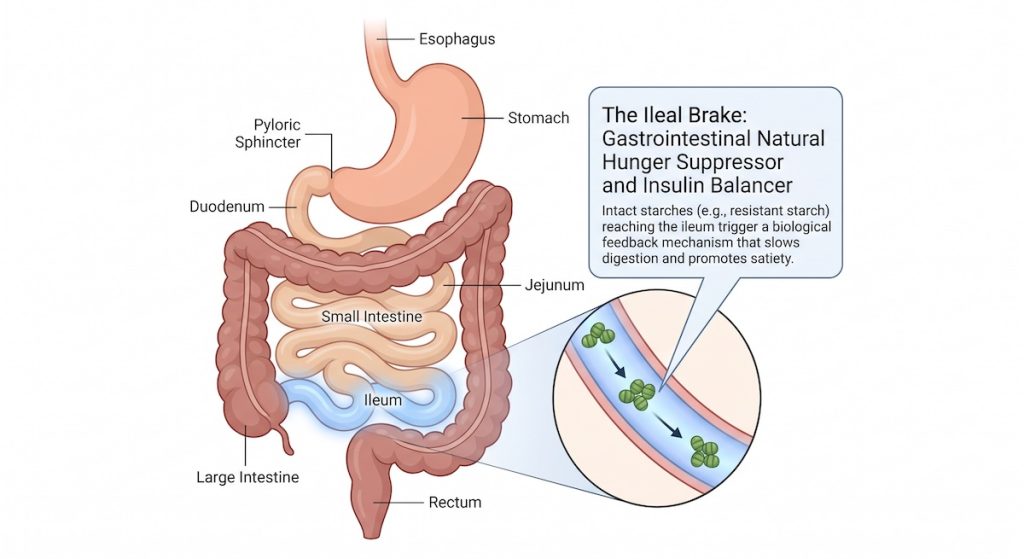
When intact starches hit the ileum, they trigger a spectacular evolutionary feedback loop that scientists call the ileal brake. This is your body’s natural, built-in mechanism to control digestion and prevent overeating. A comprehensive review published by researchers in the academic journal, Advances in Nutrition, highlights that activating this ileal brake sends immediate chemical signals to your brain and stomach, causing several profound changes:
Slowing Gastric Emptying: Your stomach naturally slows down how fast it churns and releases food, allowing you to feel physically full and satisfied for hours after a meal.
Hormone Release: It triggers a rapid release of peptide YY (PYY) and glucagon-like peptide-1 (GLP-1)—the exact satiety hormones that modern weight-loss drugs try to mimic artificially.
Blunting the Spike: It signals your upper digestive tract to slow down glucose absorption, keeping your insulin levels perfectly calm and keeping your body in a natural fat-burning baseline.
When urban islanders eat refined, processed carbohydrates, food never reaches the ileum intact. The “ileal brake” never gets applied, the hunger switch stays turned on, and the gut remains in a state of continuous metabolic friction causing visceral fat to build up.
Accessible alternatives to Taro at your local supermarket
Living in a busy urban environment means you might not always have access to a specialty island market to buy fresh, native taro. Fortunately, you don’t need to find traditional taro to get these incredible metabolic benefits. You can easily find highly effective root-crop alternatives right in the produce aisle of your local standard Western supermarket.
Here are the three best accessible workarounds that work in harmony with our unique biological engine (just a reminder – everyone is different, experiment and see how your body reacts):
White-fleshed sweet potatoes (the closest match)
While orange sweet potatoes are delicious, the white-fleshed varieties (often called sweet batatas or kumara) are your absolute best option. They contain a much lower moisture content and a denser, more complex crystalline starch structure that beautifully mimics the heavy, grounding texture of taro. When boiled or steamed, they digest incredibly slowly and provide an excellent trigger for your internal ileal brake.
Standard russet or sebago potatoes (cooked and cooled)
This is great news for potato lovers (like me!), plain white potatoes often get a bad reputation in Western diet trends, but they are a fantastic tool when prepared correctly. To maximise their resistant starch, boil or roast whole Russet or Sebago potatoes, and then place them in the refrigerator to cool completely overnight.
As the potato cools, a process called retrogradation occurs, the digestible starches physically recrystallise into tough resistant starch. Eating them cold in a salad, or gently reheating them the next day, delivers a massive dose of slow-burning fuel straight to your lower gut.

Cassava / yuca (the frozen section secret)
Most major Western supermarkets now stock whole cassava (also known as yuca) in the exotic produce aisle or cut up into convenient bags in the frozen vegetable section. Cassava is an incredible ancestral alternative; it is extremely dense, naturally gluten-free, and provides a heavy, satisfying starchy base that keeps your blood sugar flat-lined and your energy perfectly stable throughout a busy corporate workday.
The protein-first strategy for perfect insulin control
Swapping out white flour for slow-burning root starches is only half the battle. To completely eliminate bloating and optimize your metabolism, you also need to look at how you eat your meals.
When you sit down to lunch or dinner, your natural habit might be to grab a forkful of rice, a piece of bread, or a bite of potato first. But sending carbohydrates into an empty stomach, even healthy, complex ones, can still cause a sharper rise in blood sugar than your body wants.
To fix this, we implement a simple biomechanical rule: The Protein-First Rule. A breakthrough clinical trial published by researchers in The Journal of Clinical Endocrinology & Metabolism demonstrated that changing the specific order of food intake has an incredible impact on your insulin levels.
Protein First ➔ Triggers Stomach Acid & Enzymes ➔ Slows Down Stomach Churning ➔ Root Starch Slow Digestion ➔ Smooth Energy Line
When you consume your protein source, such as grilled chicken, lean beef mince, lamb, or wild salmon, before touching your root starches or cooked vegetables, your body naturally primes its digestive tract. Protein stimulates the release of stomach acid, activates protective digestive enzymes, and naturally slows down your stomach’s churning speed.
By the time you eat your white sweet potato or cooled potato slices a few minutes later, your digestion has been slowed down so effectively that glucose trickles into your bloodstream like a dripping tap. This simple shift entirely bypasses the insulin surges that cause belly fat storage, keeps your energy sharp, and ensures you stay full and clear-headed until evening.
I have tested eating in this order myself. For 2 weeks I used a Linx continuous glucose monitoring (CGM) patch and the glucose ‘line’ stayed steady, even when eating normal potatoes without cooling them. These are my personal results, and I do highly recommend trying a CGM patch yourself as it also indicates if your insulin is doing what it should (consult your health professional first).
Your zero-bloat lunchbox matrix
To help you seamlessly integrate these ancestral starches and eating strategies into a busy corporate workweek, here is a simple, practical meal blueprint. This matrix is designed to easily pack into a work lunchbox, using standard ingredients you can buy at any Western grocery store while keeping your gut flat and calm. I always try and buy organic or next best quality, contrary to popular belief it is not more expensive than non-organic, but I won’t go into that here – it is certainly worth researching for yourself.
| Order | Food Category | Urban Supermarket Choices | Purpose for Your Engine |
| Step 1: Eat This First | Clean Protein Anchor | Diced chicken breast, grass fed beef mince, canned wild salmon, or boiled eggs. | Stimulates digestive enzymes, primes stomach acid, and blunts glucose absorption. |
| Step 2: Eat This Second | Low-Fermentation Greens | Soft-cooked zucchini, peeled carrots, steamed green beans, or baby spinach. | Provides gentle fibre that doesn’t feed SIBO bacteria or trigger bloating. |
| Step 3: Eat This Last | Ancestral Root Starch | Steamed white sweet potato, or boiled-then-cooled Russet/Sebago potato slices. | Activates the ileal brake deep in your gut, locking in long-term energy. |
| Step 4: Flavor & Fat | Clean Culinary Accents | A drizzle of cold-pressed avocado oil, a pinch of sea salt, or a squeeze of fresh lime juice. | Delivers healthy fats that slow digestion further without causing internal inflammation. |
By prepping your lunches using this structural layout, you are feeding your body the precise ratios it needs to stay out of a survival crisis. You will avoid the heavy post-meal fog and bloating that makes working in an office environment so uncomfortable.

The Pacific Protocol
Navigating a modern city environment doesn’t mean you have to be at the mercy of the processed, fast-burning foods that surround you. The daily energy crashes, the painful bloating, and the constant hunger cravings you experience are not signs that your body is failing you or that you lack willpower. They are simply clear, logical biological reactions to a diet that is almost the exact opposite of what your system is genetically built to handle.
You don’t need to adopt extreme, restrictive lifestyle trends to feel healthy and vibrant again. True balance happens when you stop fighting your biology and start giving your cells the slow-burning, grounding fuels they are hardwired to expect.
By stepping away from refined white flour, white bread, and fast-burning grains, and returning to the dense power of white sweet potatoes, cooled potatoes, or cassava, you manually put your digestive system back “online”. When you pair these magnificent root crops with the Protein-First Rule, you activate your built-in ileal brake, smooth out your blood sugar curves, and step into an authentic fat-burning baseline.
This practical, food-based approach to metabolic health is a core pillar of the lifestyle framework I have built inside The Pacific Protocol and its accompanying recipe book, Pacific Pan, which are both releasing very soon (sign up to the waitlist below). We are completely changing the way we look at urban health and moving past the ineffective rules of mainstream Euro-centric diet culture to optimise our daily energy and live comfortably in our own skin.
Do you notice an immediate energy crash or stomach bloat after eating white bread or rice?
Have you ever tried using white sweet potatoes or cooled potatoes as your main carb source?
Let me know your thoughts and kitchen experiments in the comments below!
*All images created in Gemini.
This article was written with the assistance of Gemini Deep Research.