
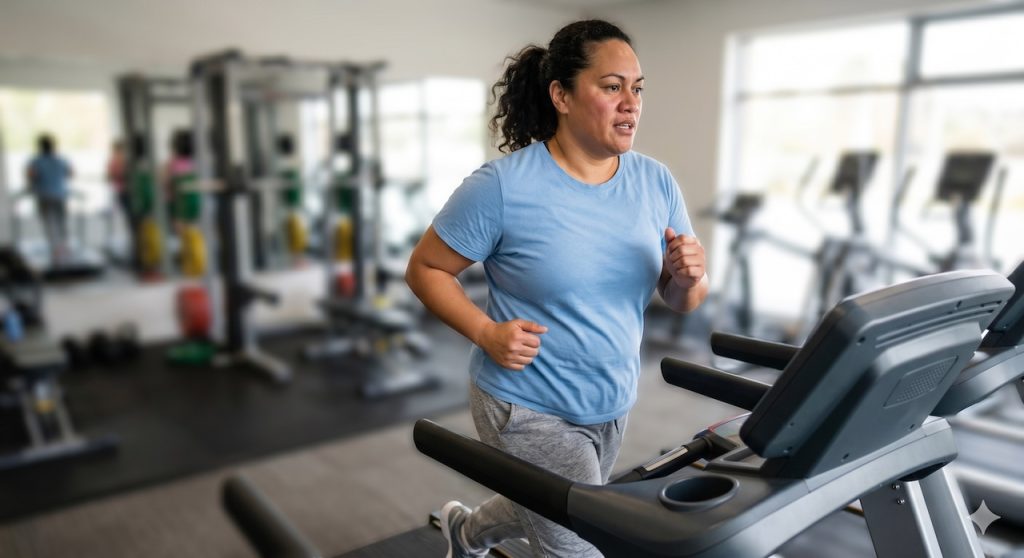
The sledgehammer approach to fitness
We’ve all been conditioned to believe a very specific story about fitness: if you want to lose weight, shift stubborn body fat, or get healthy, you have to sweat for it. Modern urban life tells working women that our morning routine should involve a punishing, high-intensity bootcamp, a fasted five-kilometre run, or a breathless interval session on a stationary bike before we even open our emails. We lace up our expensive sneakers, down a hot coffee, push our heart rates into the red zone, and wait for the transformation to happen.
But for many urban Pacific Islander women, that transformation never arrives. Instead, the scale doesn’t budge, the midsection feels permanently swollen, and a heavy, deep-seated exhaustion settles into our bones by noon.
Important Note: This information is based entirely on my own personal research and health journey.
I am not a medical professional, so please always do your own research and consult a doctor before changing your routine.
We are all unique and our genetic mixes fall on a sliding scale rather than one-size-fits-all, so consider these points as simple, empowering tools to help you uncover your own optimal nutrigenomics path.

For years, mainstream fitness experts have told us that if we aren’t seeing results, we simply aren’t trying hard enough, or we need to try something with equipment or supplements they just happen to be selling. They tell us to cut more calories and push through the fatigue. But what if the fitness industry’s favourite tool—high-intensity, stress-inducing exercise—is actually acting like a biological sledgehammer to our unique Pacific Islander genetic makeup?
The truth is, our ancestral biology runs on an entirely different engine than the one Western fitness models were built to train. When we force our bodies into high-stress, explosive workouts, we trigger a massive wave of internal inflammation and lock our fat cells into deep self-protection mode.
This article breaks down the precise genetic and physical reasons why mainstream cardio protocols are inefficient for our lineage, how our muscle structure is built for a completely different kind of movement, and how you can work with your body to unlock flat-line energy. I am also releasing two books very soon to help with your research, The Pacific Protocol, and accompanying recipe book, Pacific Pan, please subscribe at the end of this article to join the waitlist.
I encourage you to research and experiment and find out what balance is more effective for your particular partiality to Pacific Islander heritage. As a 50% Melanesian, 50% Caucasian person, I’m ok with medium to high cardio fitness movement, but I also find benefits in a weighted walk (rucking) for 30mins+ per day – find out what works for you and use the information below to help you search out your areas of interest.
The Cortisol collision
Why high-intensity workouts lock in visceral fat
To understand why extreme workouts fail our Pacific Islander biology, we have to look at how our bodies process stress. When you subject your system to a frantic morning workout, your brain doesn’t know you’re trying to fit into a corporate wardrobe—it simply registers a severe physical crisis. It activates the sympathetic nervous system, shifting your body into a “fight-or-flight” survival state.
This survival state releases a flood of cortisol into the bloodstream. In ancestral times, a surge of cortisol was meant to keep humans alive during temporary periods of severe environmental pressure or food scarcity. Once the pressure passed, cortisol levels dropped, and the body returned to balance.
However, modern urban working women are already operating under a heavy baseline of mental and emotional stress. We navigate demanding work deadlines, family responsibilities, and financial pressures. When you layer an explosive, high-intensity workout on top of an already overloaded nervous system, your cortisol levels don’t just spike—they stay up.

For women carrying our specific genetic background, this chronic cortisol elevation acts as a direct command to store energy as deeply as possible. Instead of burning fat, the body aggressively channels lipids into visceral adipose tissue (VAT)—the deep belly fat that wraps around internal organs.
This creates a state of chronic, low-grade metabolic inflammation. This continuous internal friction impairs gut function, disrupts cellular health, and causes that classic, heavy feeling of physical lethargy that leaves you completely drained before your workday has even truly begun.
The slow-twitch secret
Our hidden muscle architecture
Mainstream fitness culture is obsessed with explosive power, speed, and high-intensity depletion. But evolutionary medicine tells a completely different story about the women of Oceania. For thousands of years, our ancestors developed physical traits designed for incredible endurance, steady energy preservation, and rhythmic pacing over long distances.
Because of this unique ancestral journey, our muscle tissue possesses a powerful genetic bias toward slow-twitch (Type I) muscle fiber dominance.
Understanding the two systems
Human muscles are made up of two distinct types of fibers, each designed for a completely different survival task:
- Fast-Twitch (Type II) Fibres: Built for short, explosive, high-intensity bursts of speed and power. They burn through sugar (glycogen) rapidly, exhaust very quickly, and trigger a massive, immediate stress response in the body.
- Slow-Twitch (Type I) Fibres: Built for endurance, steady pacing, and long-term energy efficiency. They are packed with mitochondria—the tiny power plants inside your cells—and are uniquely optimised to utilise oxygen and burn fat as a continuous, steady fuel source.

When you force a slow-twitch dominant body through a frantic, breathless bootcamp or a high-intensity interval session, you are forcing a system built for steady endurance to operate like an explosive drag-racing car. Because the system isn’t optimised for that kind of stress, it runs out of fuel almost instantly, sparks a massive cellular crisis, and causes systemic inflammation. The body responds by fiercely holding onto its fat stores as a survival mechanism, assuming that a severe environmental crisis is underway.
Reclaiming the muscle anchor
What the science actually shows
The idea that women must focus entirely on burning calories through endless cardio to stay healthy is a fundamental misunderstanding of human metabolism. This is especially true as we approach midlife and transition out of our reproductive years.
A landmark clinical study conducted by researchers at the University of Otago examined the precise relationship between body composition and bone health in pre-menopausal Pacific Islander women.
The lean mass anchor explained
The University of Otago study revealed a profound biological truth: the single most powerful predictor of total body bone mineral density (BMD) in our lineage is bone-free, fat-free lean mass.
Skeletal Muscle Mechanical Load ➔ Bone Mineral Density Built ➔ Metabolic Protection
This means that the physical weight and mechanical pull of healthy skeletal muscle tissue is what actually signals our bones to stay strong, dense, and resilient. A dedicated cross-sectional analysis led by researchers at the University of Otago confirmed that while age is positively associated with bone density in this group, percent body fat is often inversely associated. This proves that building lean muscle tone—not storing excess fat or burning away muscle with endless cardio—is our ultimate biological protective anchor.
As women cross into their late 40s and 50s, a natural decline in estrogen levels causes a sharp drop in resting metabolic rate (RMR). If a woman has spent years wearing down her muscle tissue with exhausting cardio workouts, her body loses its primary metabolic buffer.
Without adequate muscle mass to soak up glucose from the bloodstream, the drop in estrogen causes deep visceral belly fat to rapidly expand, drastically increasing the risk of insulin resistance and chronic fatigue. In fact, long-term multi-ethnic tracking by the Study of Women’s Health Across the Nation (SWAN) highlights how these rapid metabolic shifts in midlife can completely alter our structural baseline if our underlying muscle health isn’t protected.
Moving for fat loss and pacing
If punishing cardio workouts trigger a fat-storage response and wear down our essential lean muscle mass, what is the alternative? How does an urban working woman stay fit, lean, and energised without driving her body into a state of panic?
The answer lies in shifting our movement style from a message of threat to a message of safety. Instead of trying to exhaust the body, we want to stimulate our slow-twitch muscle fibers using steady, low-impact, rhythm-based movement. This allows the body to smoothly burn fat for fuel without triggering the survival cortisol spikes that lock energy away.

Here are the three foundational movement tools designed to work in absolute harmony with our unique biological engine:
1. The afternoon lymphatic rebound (5-10 minutes)
The lymphatic system is your body’s internal waste clearance network. It is responsible for flushing out cellular debris, waste products, and old, used hormones that can recirculate in the bloodstream and show up as skin issues like chronic adult back acne.
Unlike the circulatory system, your lymph has no central pump—it relies entirely on physical movement to flow. Spending 5 to 10 minutes performing a gentle health bounce on a mini-trampoline (rebounder) sometime between 3:00 PM and 5:30 PM acts as a manual pump for this system. The gentle vertical motion flushes out trapped waste and lowers systemic inflammation without stress.
2. Slow-tempo strength training (20-30 minutes)
To build the vital lean mass anchor highlighted by the University of Otago research, we must lift weights, and the style must be controlled. Focus on slow, heavy, compound movements—such as squats, lunges, and overhead presses—using dumbbells or resistance bands.
Perform each movement with a deliberate 3-second lowering phase and a 1-second lift. This continuous time-under-tension builds strong muscle fibres, primes your cells to soak up glucose, and strengthens bones without sending your heart rate into a panicked, frantic red zone.
3. Nasal-breathing walking intervals
Walking is one of the most powerful fat-burning tools available to our biology—but only when done correctly. When you go for a walk, keep your mouth completely closed and breathe exclusively through your nose.
Nasal breathing naturally activates the parasympathetic nervous system (the “rest-and-digest” switch), keeping your body in a calm, fat-burning baseline. If you find yourself gasping for air through your mouth, you’ve pushed too hard and triggered a sympathetic stress response. Slow your pace down until you can easily maintain smooth, deep nasal breaths.
The Pacific Protocol
Integrating these ancestral movement principles into a busy corporate workweek doesn’t require hours of dedication. It requires consistency and proper timing. By aligning your exercise with your body’s natural daily hormonal curves, you can maximise fat burning while protecting your nervous system from depletion.
This schedule completely avoids long, gruelling morning cardio sessions. By moving your structured workouts to the afternoon window, when your body’s natural cortisol levels are already declining, you prevent the unnatural stress spikes that cause your system to stubbornly hold onto visceral fat. There will be a specific exercise planner included in my upcoming book, The Pacific Protocol, and to be first on the waitlist, subscribe to my Nuisletter below.
Reclaiming your energy, clearing internal inflammation, and reshaping your body is not a matter of fighting against your physical nature. The chronic exhaustion and stubborn weight gain that many urban working women experience are not signs of personal failure, nor do they mean your body is broken. They are simply the logical result of forcing a beautiful, highly efficient ancestral engine to run on a chaotic, high-stress modern blueprint.
Mainstream fitness culture will continue to tell you that pushing harder is the only way forward. But true metabolic balance happens when you stop fighting your biology and start sending your cells a genuine message of safety.
By trading breathless, high-stress cardio for slow-tempo strength training, protecting your sleep rhythms, and pumping your lymphatic system with gentle, low-impact rebounding, you give your body exactly what it needs to thrive in an urban environment. Your muscles become a powerful anchor for your health, your cortisol levels stabilise, and your body naturally steps out of emergency storage mode.
This gentle, science-backed approach to movement is a core pillar of the lifestyle framework I have built in my book, The Pacific Protocol, and its accompanying recipe guide, Pacific Pan, which are both launching very soon. We are stepping completely away from the punishing, restrictive rules of modern Euro-centric diet and fitness culture to better support our biology and protect our long-term vitality.
Thank you for joining me on this journey of discovery!
Do you find yourself completely exhausted by noon after a hard morning workout?
Have you noticed that punishing cardio sessions make your stomach feel more bloated or inflamed?
Let me know your thoughts and experiences in the comments below!
*All images created in Gemini.
This article was written with the assistance of Gemini Deep Research.